
Welder Trade Tests in Vietnam for Korean Employers: A Practical Recruitment Guide
Welder trade tests in Vietnam help Korean employers assess candidates before committing to overseas recruitment. A well-designed practical test provides evidence of welding ability, familiarity with the required process and capacity to follow technical instructions.
For shipyards, fabrication companies and welding subcontractors, the value of testing depends on how closely the assessment reflects the actual job. A general welding demonstration may show basic technique, but it does not necessarily establish suitability for a particular production assignment.
Employers need a clear test specification, suitable facilities, competent assessors and traceable results. They also need to distinguish recruitment screening from formal welder qualification.
This guide explains how Korean employers can plan welding skills assessments in Vietnam, review candidates and use test results to make more informed recruitment decisions.
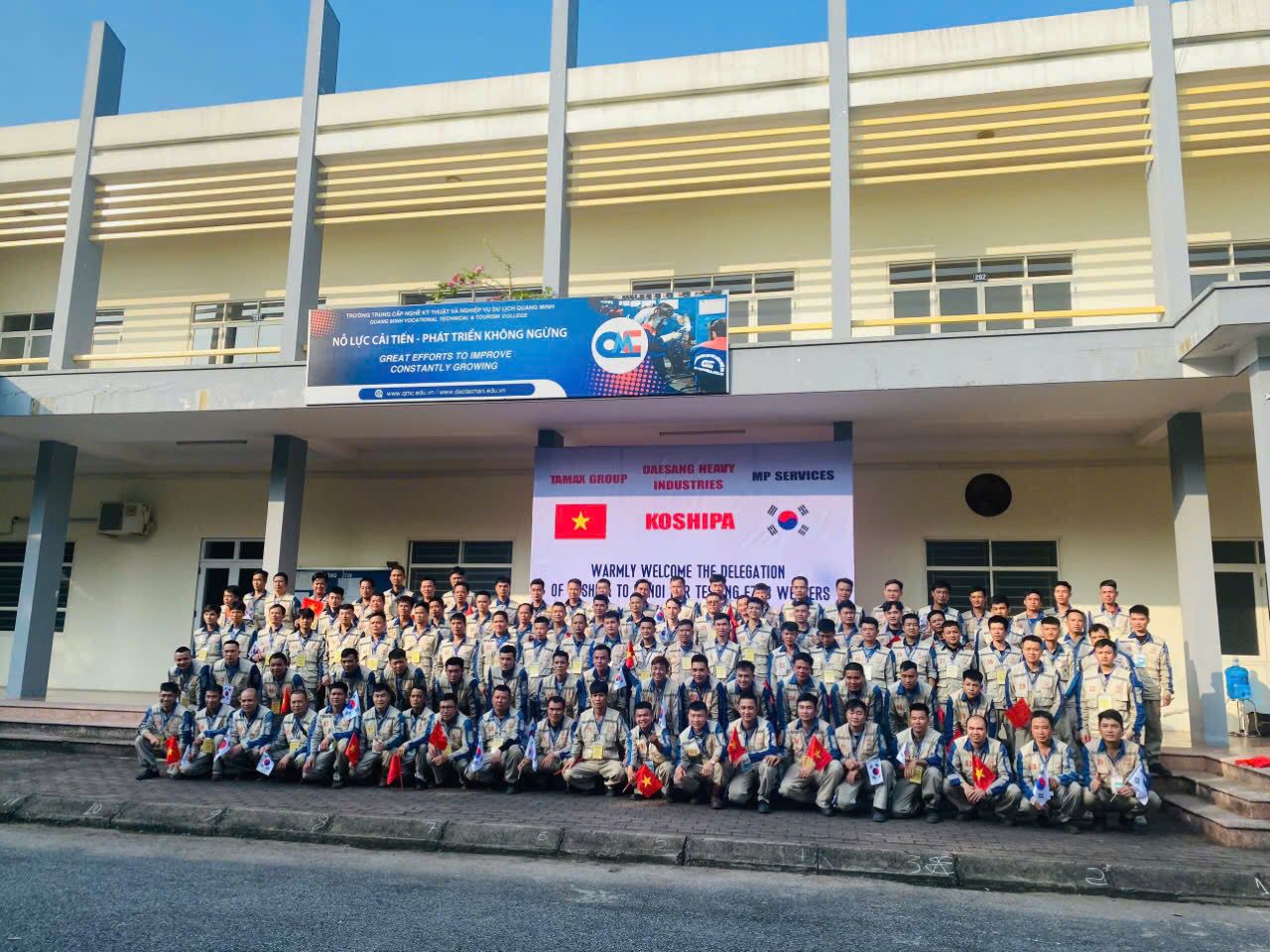
The welding skills test is administered by the Koship shipbuilding association to assess and evaluate the skills and abilities of Vietnamese welders.
Why Conduct Welder Trade Tests Before Recruitment?
A candidate’s employment history offers useful background, but it cannot fully demonstrate current welding ability. Job titles may cover different duties, and previous projects may have used different materials, welding processes or acceptance requirements.
Practical testing allows employers to observe how candidates prepare, interpret instructions and complete a defined welding task.
It can help answer important recruitment questions:
- Does the candidate have experience with the specified welding process?
- Can the worker follow the supplied welding instructions?
- Is the workmanship suitable for the proposed assignment?
- What additional training or supervision is needed?
- Does the candidate demonstrate appropriate safety judgment?
Testing before departure also gives both parties a clearer understanding of the role. Employers can explain their expectations, while candidates can see the type of work they are being recruited to perform.
The objective is reliable evidence for selection, supported by accurate documentation.
Recruitment Trade Tests and Formal Welder Qualification
A recruitment trade test is an employer’s assessment of a candidate’s suitability for a job. It may include practical welding, drawing interpretation, an interview and observation of working methods.
Formal welder qualification follows the requirements of a specified standard or code. Its scope, examination, records and acceptance arrangements must comply with that framework.
TWI explains that welder qualification evaluates a welder’s ability to produce welds to an industry standard while following a welding procedure. Acceptance of qualification certification also depends on the applicable requirements and examining arrangements.
These distinctions matter when communicating results. Passing an internal recruitment test should be described accurately as passing that assessment.
It should not automatically be advertised as an AWS, ISO or classification society certification. Employers must confirm whether a formal qualification is required and who is authorized or accepted to witness, examine and issue the relevant records.
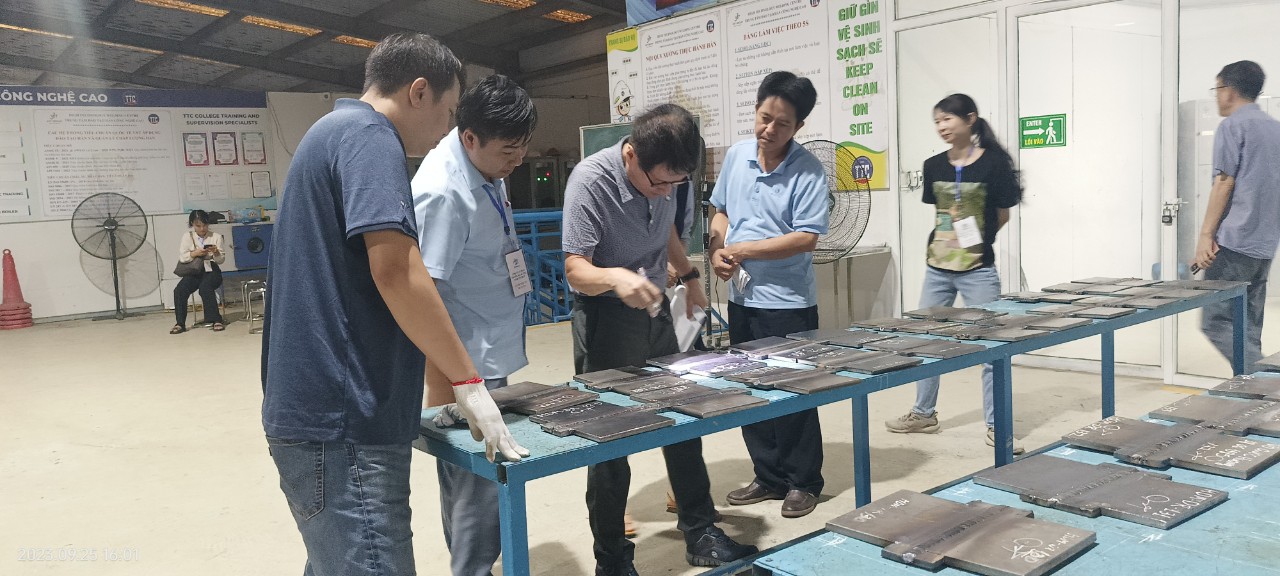
Checking and evaluating the appearance of each welding test in Vietnam.
Start with the Korean Employer’s Welding Requirements
Before candidates are invited, the employer should provide a written technical brief.
A useful brief identifies the proposed work, welding process, material and expected level of independence. It should also specify whether the assessment is recruitment screening, formal qualification or both.
Key details include:
| Test planning item | Information to agree |
|---|---|
| Job scope | Ship structures, pipework, fabrication or another defined assignment |
| Welding process | The specific process or combination required |
| Test material | Material specification and relevant dimensions |
| Joint configuration | Butt weld, fillet weld or another specified arrangement |
| Position | The exact position and progression required |
| Welding instructions | Applicable WPS and supporting instructions |
| Inspection | Examination methods and acceptance criteria |
| Witnessing | Employer, examiner or other agreed representative |
| Reporting | Required records and decision format |
Unresolved technical details should be settled before testing begins. Otherwise, the employer may receive results that cannot support the intended hiring decision.
Selecting Welding Processes for the Assessment
The test should use the process required for the position. Familiarity with one welding process does not establish competence in another.
FCAW Trade Tests
Flux-cored arc welding assessments should match the employer’s specified application and consumable system.
Candidates can be observed on their ability to prepare equipment, interpret instructions and maintain consistent welding technique.
Employers should verify whether the candidate’s previous experience involved the same type of FCAW application being assessed. Broad statements such as “experienced in flux-cored welding” need supporting detail.
GMAW Trade Tests
For gas metal arc welding, the test should define the required setup and welding conditions.
Candidates should demonstrate familiarity with the equipment and the ability to follow the supplied procedure. Where process variants or transfer modes matter to the assignment, they should be addressed explicitly in selection and testing.
GTAW Trade Tests
Gas tungsten arc welding assessments should reflect the material, joint and task involved.
A worker experienced in one GTAW application may need separate assessment for a substantially different assignment. Employers should identify whether the role includes root welding, complete joint welding or another defined responsibility.
SMAW Trade Tests
Shielded metal arc welding candidates should be assessed against the specified consumables, joint and position.
Previous experience should be reviewed alongside practical performance, especially where the proposed work differs from the candidate’s earlier assignments.
For combined-process roles, each relevant part of the assignment needs appropriate assessment.
Korean employers directly assess the skills of Vietnamese welders.
Choosing Welding Positions and Test Scope
Terms such as 3G, 4G and 6G are frequently used in recruitment discussions. However, a position label alone is not a complete test specification.
The employer must also define the material, joint configuration, dimensions, process and other applicable variables.
Passing a test in one position does not automatically qualify a worker for every material, thickness, process or production task. Any formal range of qualification must be determined under the governing requirements.
The assessment should also distinguish plate welding from pipe welding where relevant.
For recruitment purposes, employers should select a test that provides useful evidence for the actual job. Making a test more difficult without connecting it to the assignment does not necessarily improve candidate selection.
Using the Applicable Welding Procedure
The welding procedure specification, or WPS, provides the instructions applicable to the welding task.
AWS guidance on performance qualification emphasizes that welders follow a WPS applicable to the qualification, including the relevant essential variables and limitations. The employer should confirm the requirements of the code and edition governing its project.
Candidates should receive the appropriate instructions and have an opportunity to clarify terminology before the assessment starts.
Assessors can then observe whether they understand the required process, consumables, joint details and working sequence.
Welder qualification and welding procedure qualification are different activities. TWI distinguishes a welder approval test, which evaluates an individual’s skill, from procedure approval, which addresses the welding procedure.
An employer should therefore avoid assuming that a successful candidate test establishes a new production procedure.
Preparing a Suitable Test Facility in Vietnam
The testing facility should support consistent conditions across candidates.
Employers should review equipment availability, workstations, material preparation, consumable control and inspection arrangements before confirming the event.
Useful facility checks include:
- Suitable welding equipment for the required process.
- Adequate work areas and ventilation arrangements.
- Consistent preparation of test materials.
- Identification and control of consumables.
- Safe handling arrangements.
- Space for observation and inspection.
- A system for tracking candidates and test pieces.
The employer should also establish who provides the WPS, materials, consumables and examination services.
If formal qualification is intended, the facility and witnessing arrangements must satisfy the applicable requirements. A workshop’s capacity to host recruitment tests does not by itself establish authority to issue recognized qualifications.
A Step-by-Step Testing Process
1. Screen Candidate Experience
Review employment history, previous welding assignments and relevant training records.
Candidates should explain which processes they used, what they welded and how their work was inspected. Specific examples are more informative than a general statement of years of experience.
Existing certificates should be reviewed for scope and relevance.
2. Verify Identity and Assign Test References
Match the candidate to the recruitment records and assign a unique reference.
Test pieces and associated reports should be linked to that reference. The tracking system should remain clear throughout preparation, welding, inspection and reporting.
This reduces the risk of confusing results between candidates.
3. Conduct the Briefing
Explain the test purpose, instructions, permitted activities and assessment criteria.
Candidates should understand how questions will be handled and what assistance is allowed. Language support can clarify instructions without coaching the candidate through the assessed task.
All candidates should receive consistent information.
4. Observe Preparation and Welding
Assessors should record relevant observations during the work.
These may include interpretation of instructions, preparation, equipment familiarity, working sequence and response to problems.
Observation helps distinguish a strong finished result from a process that involved unauthorized assistance or departures from the agreed requirements.
5. Complete the Required Examination
Inspect the test piece using the methods agreed before testing.
The examination scope and acceptance criteria should follow the governing requirements where formal qualification is involved.
Recruitment decisions should also consider relevant observations that fall outside the weld examination itself, such as communication and working discipline.
6. Issue Individual Results
Provide a clear result for each candidate.
Where further training or retesting is proposed, identify the reason and the next assessment required. Avoid reporting only a group pass rate without individual evidence.
Inspection and Acceptance Criteria
Visual examination can provide information about the finished weld and visible imperfections. Depending on the test purpose and governing requirements, additional examination may be necessary.
Radiographic testing, ultrasonic testing or mechanical tests should not be added or substituted casually. The selected methods, limitations and acceptance criteria need technical review.
A recruitment score and a formal qualification decision should also remain distinct.
For example, an employer may assess preparation, communication and work organization in addition to weld quality. Those observations can inform hiring, but they do not replace mandatory qualification requirements.
Retest conditions should be agreed in advance. If a candidate receives further training, the subsequent result should be recorded transparently rather than merged with the original assessment.
Documentation Korean Employers Should Receive
A useful candidate report should make the assessment traceable and understandable.
Depending on the test purpose, records can include:
- Candidate identity and reference number.
- Test date and facility.
- Welding process and test configuration.
- Material and consumable information.
- Applicable WPS reference.
- Assessor and witness details.
- Examination reports.
- Test result and recruitment recommendation.
- Identified limitations or training needs.
Photographs and video can supplement these records. They should be linked to the correct candidate and test piece.
Formal qualification documents require the information specified by the applicable framework. A recruitment partner should describe what it can provide and what requires an accepted examiner or certification arrangement.
On-Site and Remote Employer Participation
Korean employers can participate directly by sending welding specialists or production representatives to Vietnam.
This allows immediate discussion of candidate performance and gives the employer an opportunity to inspect the facilities and testing arrangements.
Remote participation may also support recruitment screening where travel is impractical. Employers should agree on camera coverage, identity verification, observation and reporting.
Remote video alone may not satisfy formal witnessing requirements. Those requirements must be confirmed separately.
Whichever format is chosen, the employer should retain a clear basis for its final selection decisions.
Turning Test Results into Recruitment Decisions
Test results should support a decision about the actual position.
Candidates may be approved, declined or referred for further preparation and reassessment. Employers can also distinguish workers suited to particular tasks or supervision levels.
A strong performance on one test should not be extended to duties outside the demonstrated scope.
Technical approval is also separate from immigration eligibility. For recruitment involving a proposed Korean work visa route, employers should confirm current requirements for the occupation, company and candidate.
Passing a welding assessment does not guarantee visa approval or replace any separately required official skills verification.
Frequently Asked Questions
What is a welder trade test?
It is a practical assessment used to evaluate welding ability for a defined purpose. A recruitment trade test supports hiring decisions, while formal qualification follows a specified standard or code.
Can Korean employers conduct welder tests in Vietnam?
Tests can be organized at suitable facilities with agreed technical and assessment arrangements. Employers should confirm any additional requirements where formal qualification or official verification is intended.
Does passing a trade test mean the welder is certified?
Not automatically. Certification or qualification claims must reflect the governing requirements, examination arrangements and documents issued. An internal recruitment assessment should be described as such.
Which welding process should be tested?
The process required for the job. If the assignment involves multiple processes, the assessment should address the relevant duties rather than rely on an unrelated welding demonstration.
Should employers test every candidate in 6G?
The test should match the assignment. A 6G test may be relevant to particular pipe welding roles, but it is not a universal recruitment requirement for all welding positions.
Are RT or UT required for every test?
No single examination method applies to every assessment. The required methods depend on the test configuration, governing requirements and agreed acceptance criteria.
Can employers review candidates remotely?
Remote review can support recruitment screening with suitable identity checks and documentation. Acceptance for formal witnessing must be confirmed under the applicable requirements.
Does a successful test guarantee employment or visa approval?
No. Employers must also review experience, documentation, employment conditions and applicable eligibility requirements before confirming deployment.
Plan Welder Trade Tests in Vietnam
Effective welder trade tests in Vietnam begin with a clear understanding of the Korean employer’s production requirements.
The assessment should use relevant welding tasks, consistent conditions and traceable examination results. Accurate reporting helps employers select suitable candidates and identify preparation needs before departure.
Korean shipyards and subcontractors exploring recruitment cooperation with VXT GROUP can start by sharing their required welding processes, positions, materials, candidate numbers and assessment expectations.
A project-specific discussion can then establish the testing scope, facility arrangements, witnessing requirements and reporting format, providing a practical foundation for recruiting Vietnamese welders.
Contact Vietnam Manpower Supply Agency today to discuss your specific workforce needs and discover the difference that skilled Vietnamese workers make.
Do you want to hire #workers, seasonal workers and long-term workers from Vietnam?
But you don’t know about:
❓ What kind of service we provide?
👉 Consulting on finding Vietnamese welders
👉 Looking for a supply of welder human resources
👉 Consult about Vietnam’s labor market
👉 Source suitable workers meeting your requirements
👉 Take documents procedures in Vietnam
👉 Train workers languages and vocational skills
👉 Handle problems while Vietnamese workers work in EU
Please contact #Vietnammanpowersupply for #internationalhiring,
We will support you to do all things.
DETALL: #GLOBALSTAFFRECRUITMENT
Tel/Whatsapp: (+84 ) 982 0303 66 – CEO
🌐 LinkedIn: https://www.linkedin.com/company/vietnam-human-resources-group/
Website: vnmanpower.net
Email: namnq.vtc@gmail.com
Youtobe: https://www.youtube.com/@vietnammanpowersupply
#InternationalRecruitmentAgency #ManpowersupplyAgency #vietnammanpowersupply #manpoweragency #manpowersupply #manpowergroup #manpowervietnam #manpowercompany #manpowersupplycompany #Weldersupply #Supplyofshipwelders #weldermanpowersupply