
Organization of Welding Skills Tests in Vietnam for Korean Shipyard Recruitment
Organizing welding skills tests in Vietnam helps Korean shipyards and subcontractors evaluate candidates before overseas recruitment proceeds. A properly organized assessment connects the employer’s technical requirements with verified candidate experience, qualification documents and practical performance.
The process involves more than preparing welding machines and inviting applicants. Organizers must verify identities, review certificates, define the test specification and maintain traceability throughout welding and inspection.
For recruitment involving association-led skills verification, the Vietnamese supplier and Korean employer must also coordinate the required registration and documentation under the applicable assessment arrangements.
This guide explains how to organize welding proficiency tests in Vietnam for 3G, 4G and 6G candidates, including preparation for Korean shipbuilding recruitment and coordination with KOSHIPA where required.
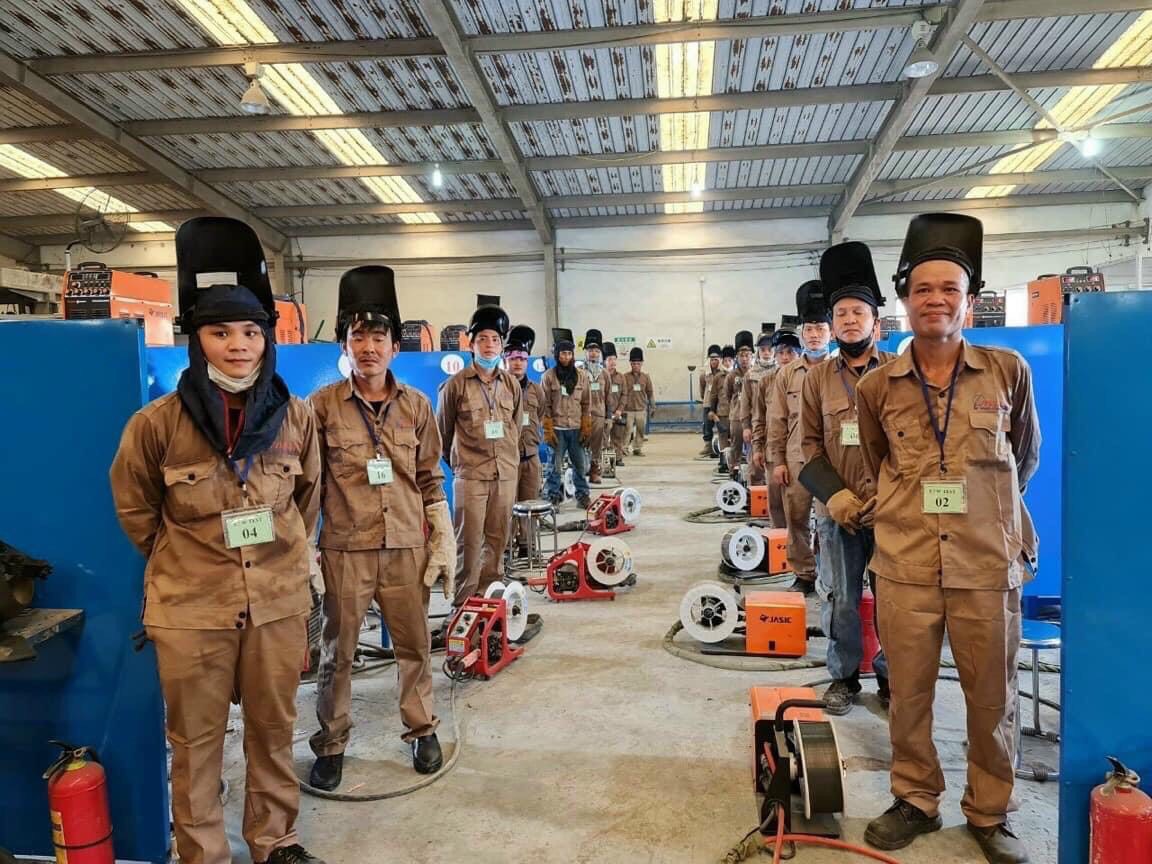
Vietnamese welders hone their skills before taking the Korean Shipbuilding Association (KOSHIPA) certification exam.
1. Establish the Purpose of the Assessment
Before inviting candidates, determine whether the event is an employer recruitment test, a formal welder qualification test or an assessment connected with a specific Korean recruitment pathway.
These activities may overlap, but their requirements are not automatically identical.
An employer’s screening test helps establish suitability for a job. Formal qualification follows a specified technical framework. Association-led verification follows the requirements of the relevant program and assessment notice.
The organizer should identify who accepts the result, who assesses the candidate and which records will be issued.
This avoids a common mistake: describing an internal trade test as an association certificate or internationally recognized qualification without the necessary arrangements.
2. Define the Employer’s Technical Requirements
A recruitment request for “qualified welders” needs supporting detail.
The Korean employer should specify the actual work, welding processes, materials, joint configurations and required positions.
The brief should also identify the applicable welding procedure specification, or WPS, and the examination requirements.
| Planning item | Details to confirm |
|---|---|
| Welding process | Required process or combination |
| Material | Carbon steel, stainless steel, aluminum or another specified material |
| Test configuration | Plate or pipe, dimensions and joint preparation |
| Position | Required 3G, 4G, 6G or other assessment |
| Instructions | Applicable WPS and supporting documents |
| Examination | Methods and acceptance criteria |
| Assessment authority | Employer, examiner or association arrangements |
| Documentation | Registration forms and result records |
Technical details should be resolved before the assessment date. Otherwise, organizers risk producing results that do not support the intended recruitment decision.
3. Verify Welders’ CVs and Employment Histories
Candidate screening should establish what the worker has actually done.
Review previous employers, employment dates, project types and welding responsibilities. A statement such as “five years of welding experience” does not identify the processes or materials involved.
Ask candidates to describe representative assignments:
- What did they weld?
- Which welding process did they use?
- What positions were involved?
- Which instructions governed the work?
- How was weld quality examined?
- What supervision did they receive?
Compare these answers with supporting records where available.
Clarify inconsistent dates, unexplained differences between documents and broad claims about experience before submitting the candidate for formal assessment.
The final profile should describe relevant competence accurately and identify any information still awaiting verification.
4. Review 3G, 4G and 6G Welding Certificates
Position labels provide useful information, but they are not complete qualification descriptions.
In common AWS terminology, 3G refers to vertical groove welding, 4G to overhead groove welding and 6G to fixed inclined pipe groove welding.
Certificate review must also identify the process, material, test dimensions, progression and applicable qualification range.
Check:
- Candidate identity and certificate reference.
- Governing standard or code.
- Welding process used.
- Test configuration and position.
- Examination results.
- Issuing or examining arrangements.
- Applicable validity and continuity requirements.
Do not assume that a 6G certificate covers every pipe material or that a 3G qualification establishes overhead competence.
A competent technical reviewer should compare each qualification with the proposed assignment.
5. Verify Welding Processes and Material Competence
The welding methods listed on the certificate must match the candidate’s claimed experience and the employer’s requirements.
Relevant processes may include SMAW, GMAW, FCAW and GTAW. Some pipe assignments involve a combination of processes, with different processes used for different portions of the joint.
Where numerical process designations appear, interpret them using the applicable documentation rather than relying on a broad label such as “MIG welding.”
Material competence also needs separate review.
A candidate experienced in carbon steel should not automatically be approved for stainless steel or aluminum. Assess the material and application required for the job.
If the employer needs workers across several materials, plan appropriate evidence or additional assessments for each relevant scope.
6. Apply the Correct International Qualification Framework
The selected standard must be suitable for the assignment.
ISO 9606 is a series with material-specific parts. ISO identifies ISO 9606-1 as covering fusion welding of steels and ISO 9606-2 as covering aluminum and aluminum alloys. A steel qualification should therefore not be presented as proof of aluminum competence.
AWS D1.1 concerns structural steel applications; it should not be used as a universal qualification framework for every material or piping assignment. Where other materials are involved, the appropriate requirements need separate technical review.
ASME Section IX may be relevant where specified by the governing project requirements.
EN 287-1 is a legacy reference. Organizers should review the original records and current project acceptance rather than assume that all older certificates remain suitable.
Always confirm the required edition and acceptance arrangements with the receiving employer or assessment authority.
Vietnamese welders take the skills test administered by the Korea Shipbuilders Association (Koshipa).
7. Review Health, Passport, Age and Background Documents
Technical screening should be coordinated with recruitment eligibility checks.
Verify the passport identity details, expiry date and any validity requirement applicable to the intended process.
Arrange health checks through appropriate providers according to the current recruitment and immigration requirements. Employers should receive the relevant fitness documentation through an appropriate, confidential process.
Review age requirements against the employer’s lawful selection criteria and the applicable program rules. Do not invent a universal age limit for shipyard recruitment.
Where criminal record documentation is required, establish the correct issuing authority, document date and translation or certification arrangements.
These checks should be completed early enough to avoid submitting candidates whose documentation prevents progression.
8. Confirm the Vietnamese Supplier’s Authorization
The Vietnamese company organizing overseas recruitment must hold the appropriate valid authorization for the arrangement.
A general overseas employment service license and a project-specific recruitment approval or labor supply contract procedure are separate matters. The supplier should confirm which documents are required for the proposed Korean order.
Vietnam’s current overseas labor authority operates under the Ministry of Home Affairs, through the Department of Overseas Labor. Older documents may reference the former Ministry of Labor, Invalids and Social Affairs. The current department’s official website reflects the Ministry of Home Affairs structure.
Before registering candidates, verify the company’s license status and complete any required approval or registration for the recruitment concerned.
Keep the relevant authorization documents available for review by the parties involved.
9. Prepare the Candidate List for KOSHIPA Coordination
Where the applicable Korean shipbuilding recruitment pathway requires KOSHIPA skills verification, coordinate registration with the association’s accepted channel.
KOSHIPA is commonly known in English as the Korea Offshore & Shipbuilding Association. Its precise role and required documents should be confirmed for the current occupation and assessment program.
The candidate list should use the required template and match passport information exactly.
Prepare supporting records specified in the current notice, which may include qualifications, experience evidence and recruitment documents.
Confirm the submission deadline, test arrangements, document corrections and who is responsible for communication.
Do not treat preliminary submission as confirmation that a candidate has been accepted for testing or certified.
10. Brief Workers on Documents and Test Materials
Candidates should receive a written briefing before the assessment.
Where required by the assessment notice, they should bring their original passports and international welding qualification documents for identity and record checks.
The briefing should explain the venue, reporting time, permitted equipment and test conditions.
Responsibility for preparing test coupons must be confirmed in writing. If candidates are instructed to prepare or bring them, organizers should provide the approved specifications and verify conformity before use.
Materials should not be sourced informally without technical control.
The employer, Vietnamese organizer and assessment authority should agree on material specifications, preparation, identification and costs. This creates consistent conditions and reduces avoidable rejection of unsuitable coupons.
11. Conduct Individual Practical Assessments
Each candidate should be assessed individually and linked to a unique test reference.
For a KOSHIPA-led event, assessment should follow the confirmed association arrangements. Examiners may be association representatives or personnel designated under those arrangements; their authority should be established before testing.
Observation should address the candidate’s ability to operate the required machinery, interpret instructions and complete the welding task.
Relevant observations include preparation, equipment familiarity, procedure compliance, working method and response to problems.
Organizers should document any permitted assistance and prevent unrecorded coaching.
The completed test piece must remain traceable to the candidate throughout examination and reporting.
12. Arrange Visual Examination and Required UT or RT
Practical performance should be followed by the examination required under the assessment plan.
Visual examination may be used to assess visible features and identify reasons for further review.
Ultrasonic Testing, or UT, and Radiographic Testing, or RT, can be specified for examining test welds. However, organizers should not assume that both methods are mandatory for every candidate and configuration.
If the current KOSHIPA assessment plan requires both UT and RT after the initial practical assessment, arrange both accordingly. Otherwise, follow the confirmed examination requirements.
The methods, acceptance criteria and personnel should be technically appropriate.
RT requires a controlled examination arrangement with radiation protection. It should be handled by authorized specialists rather than incorporated casually into a general workshop event.
13. Record Results and Manage the Next Stage
Results should be communicated through the official or agreed assessment channel.
The 2–3 working-day period can be used as a planning expectation only where confirmed for the particular event. Inspection scheduling, document review or clarification requests may affect the release date.
Do not describe an anticipated turnaround as a guaranteed association-wide deadline.
Successful candidates can proceed to the next recruitment stage once the necessary result documents are available.
For Korean employment, this may include preparation for a visa issuance confirmation or other applicable process.
Passing the assessment does not guarantee visa approval. Employer eligibility, candidate documentation and current immigration requirements remain separate checks.
14. Maintain a Complete Assessment File
A well-organized file supports employer review and later recruitment stages.
Retain the candidate profile, verified identity details, qualification records, registration information and test specification.
Include assessment observations, examination reports and the official result where issued.
Record corrections and retests transparently. A later successful test should remain distinguishable from an earlier unsuccessful result.
Limit access to personal and medical records to those who need them for the authorized process.
Receiving supervisors should obtain the technical information necessary to assign duties appropriately, while sensitive information should be handled separately.
Frequently Asked Questions
Can Korean employers organize welding skills tests in Vietnam?
Yes. They can coordinate tests with suitable facilities and recruitment partners. Association-led or formal qualification events require the relevant assessment and witnessing arrangements.
Are 3G, 4G and 6G certificates enough for selection?
They provide supporting evidence. Employers should also review processes, materials, qualification scope, relevant experience and current practical performance.
Does a carbon steel qualification cover stainless steel or aluminum?
Do not assume this. Review the applicable qualification framework and material scope, and assess additional competence where required.
Is KOSHIPA verification required for every Korean work visa?
No universal claim should be made. Confirm the requirements for the specific occupation, employer and recruitment pathway.
Must workers bring passports and welding certificates?
They should bring the originals where required by the assessment notice. Organizers should issue a clear document checklist beforehand.
Who prepares the test coupons?
Responsibility depends on the agreed assessment arrangements. Where candidates prepare them, approved specifications and conformity checks are essential.
Are both UT and RT compulsory?
Only describe both as compulsory when the confirmed assessment plan requires them. Follow the specified methods and acceptance criteria.
Are results always issued within 2–3 working days?
That timeframe should be confirmed for the event. It is a planning expectation, not a universal guarantee.
Does passing the test guarantee a Korean visa?
No. Assessment success supports the next stage, but immigration approval depends on the applicable requirements and official review.
Organize a Welding Assessment in Vietnam
Effective welding skills tests in Vietnam combine accurate candidate screening, relevant technical specifications and traceable examination results.
For Korean shipyards and subcontractors, this provides a clearer basis for identifying suitable welders before deployment.
VXT GROUP can discuss coordination with licensed Vietnamese suppliers, employer representatives and the relevant assessment parties. Employers should begin by sharing their required processes, materials, positions, candidate numbers and intended recruitment pathway.
The next step is to confirm the testing scope, registration requirements, material responsibilities and reporting schedule for the specific event.
Contact Vietnam Manpower Supply Agency today to discuss your specific workforce needs and discover the difference that skilled Vietnamese workers make.
Do you want to hire #workers, seasonal workers and long-term workers from Vietnam?
But you don’t know about:
❓ What kind of service we provide?
👉 Consulting on finding Vietnamese welders
👉 Looking for a supply of welder human resources
👉 Consult about Vietnam’s labor market
👉 Source suitable workers meeting your requirements
👉 Take documents procedures in Vietnam
👉 Train workers languages and vocational skills
👉 Handle problems while Vietnamese workers work in EU
Please contact #Vietnammanpowersupply for #internationalhiring,
We will support you to do all things.
DETALL: #GLOBALSTAFFRECRUITMENT
Tel/Whatsapp: (+84 ) 982 0303 66 – CEO
🌐 LinkedIn: https://www.linkedin.com/company/vietnam-human-resources-group/
Website: vnmanpower.net
Email: namnq.vtc@gmail.com
Youtobe: https://www.youtube.com/@vietnammanpowersupply
#InternationalRecruitmentAgency #ManpowersupplyAgency #vietnammanpowersupply #manpoweragency #manpowersupply #manpowergroup #manpowervietnam #manpowercompany #manpowersupplycompany #Weldersupply #Supplyofshipwelders #weldermanpowersupply