
Vietnam Shipbuilding Manpower Supplier for Korean Employers
Choosing a reliable Vietnam shipbuilding manpower supplier starts with understanding what your production team needs. Korean employers require workers who can perform specific tasks, follow shipyard safety procedures, understand technical instructions, and adapt to demanding production schedules.
Recruiting internationally involves more than collecting CVs. Employers need a coordinated process covering candidate sourcing, practical assessment, document verification, preparation, and support after arrival. Each stage should help answer a practical question: can this worker perform the assigned job safely and consistently?
Vietnam is a sourcing market for employers seeking welders, fabricators, pipe fitters, painters, and other marine production personnel. VXT GROUP supports recruitment cooperation between Korean employers and Vietnamese manpower partners, with an emphasis on matching workers to actual job requirements.
This guide explains how to evaluate a Vietnamese shipbuilding workforce, organize recruitment, and build a partnership that supports production continuity.
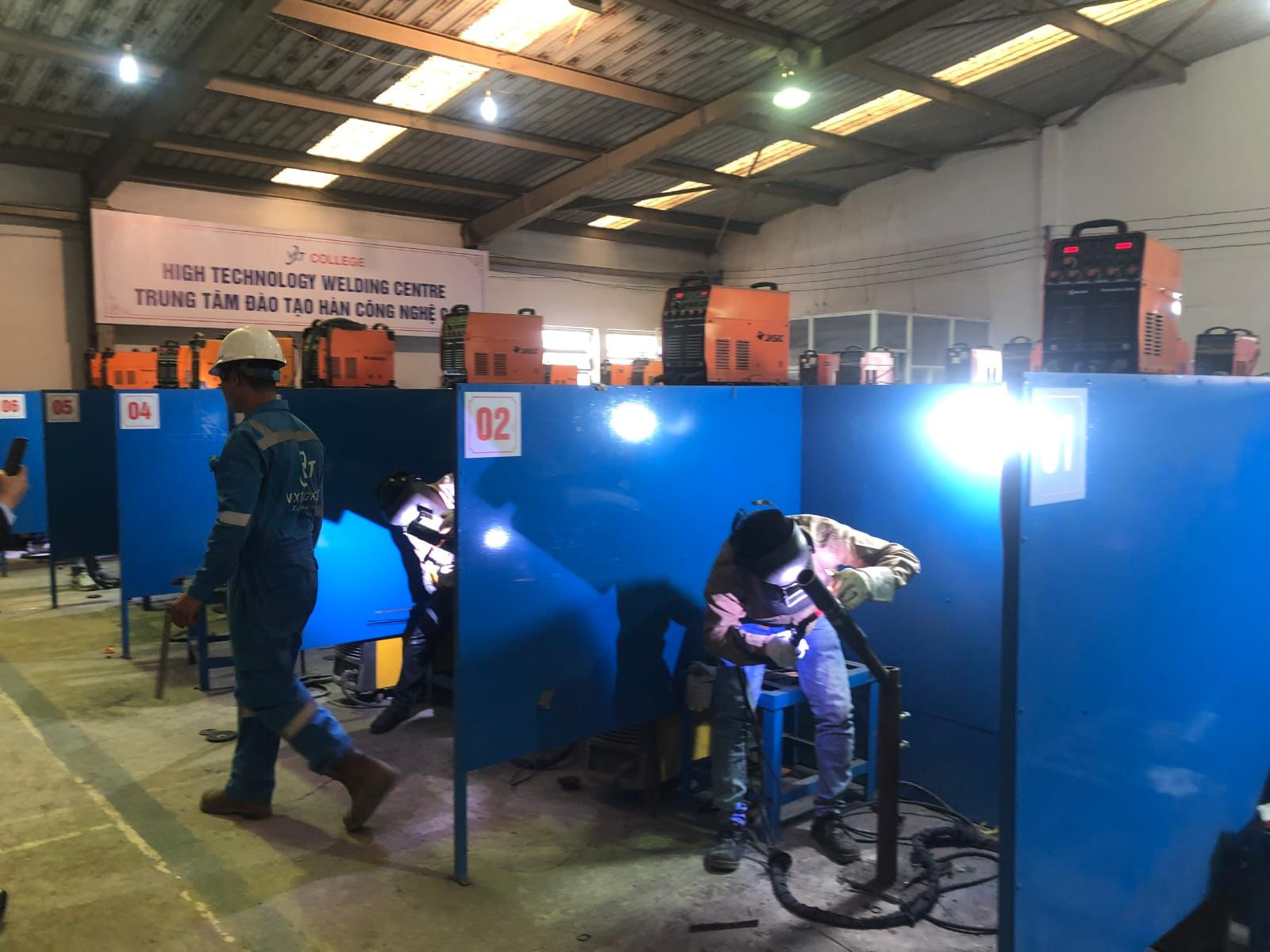
Korean shipbuilding industry manpower solutions are seeking welders from Vietnam.
Why Korean Shipbuilding Employers Consider Vietnamese Workers
Shipbuilding requires several trades to work together. Delays in fabrication can affect assembly, while incomplete piping or electrical installation can hold up outfitting. Workforce planning therefore needs to reflect the sequence of production and the skills required at each stage.
The OECD’s 2026 review of Korea’s shipbuilding industry identifies workforce constraints and describes foreign recruitment as one response to those challenges. For employers, this makes candidate quality, training, and integration central to international hiring decisions.
Vietnam offers recruitment opportunities across welding, metal fabrication, mechanical installation, and related industrial trades. Candidates may come from shipyards, steel fabrication workshops, manufacturing facilities, or construction projects.
However, industrial experience alone does not establish shipbuilding competence. A welder experienced in workshop fabrication may need additional preparation for restricted access, marine quality requirements, or a different welding procedure.
A capable supplier should identify these differences before presenting candidates. Employers benefit when recruitment decisions are based on verified experience and practical performance rather than broad job titles.
Shipbuilding Manpower That Can Be Sourced in Vietnam
A useful recruitment request specifies duties, materials, equipment, experience, and assessment criteria. The following trades can be considered for sourcing, subject to candidate availability and confirmation of the lawful employment route.
Vietnamese Welders
Welders may be recruited for hull structures, ship blocks, outfitting components, piping, or other approved assignments.
Depending on the project, employers may seek experience in:
- Flux-cored arc welding.
- MIG/MAG welding.
- TIG welding.
- Manual metal arc welding.
- Plate welding and structural fabrication.
- Pipe welding and joint preparation.
Selection should reflect the actual production requirement. A plate welder and a pipe welder may need different assessments, even when both have several years of experience.
Employers should define the welding process, position, material, thickness, joint configuration, and acceptance criteria. Any existing qualification should be checked for its scope, validity, and relevance to the proposed work.
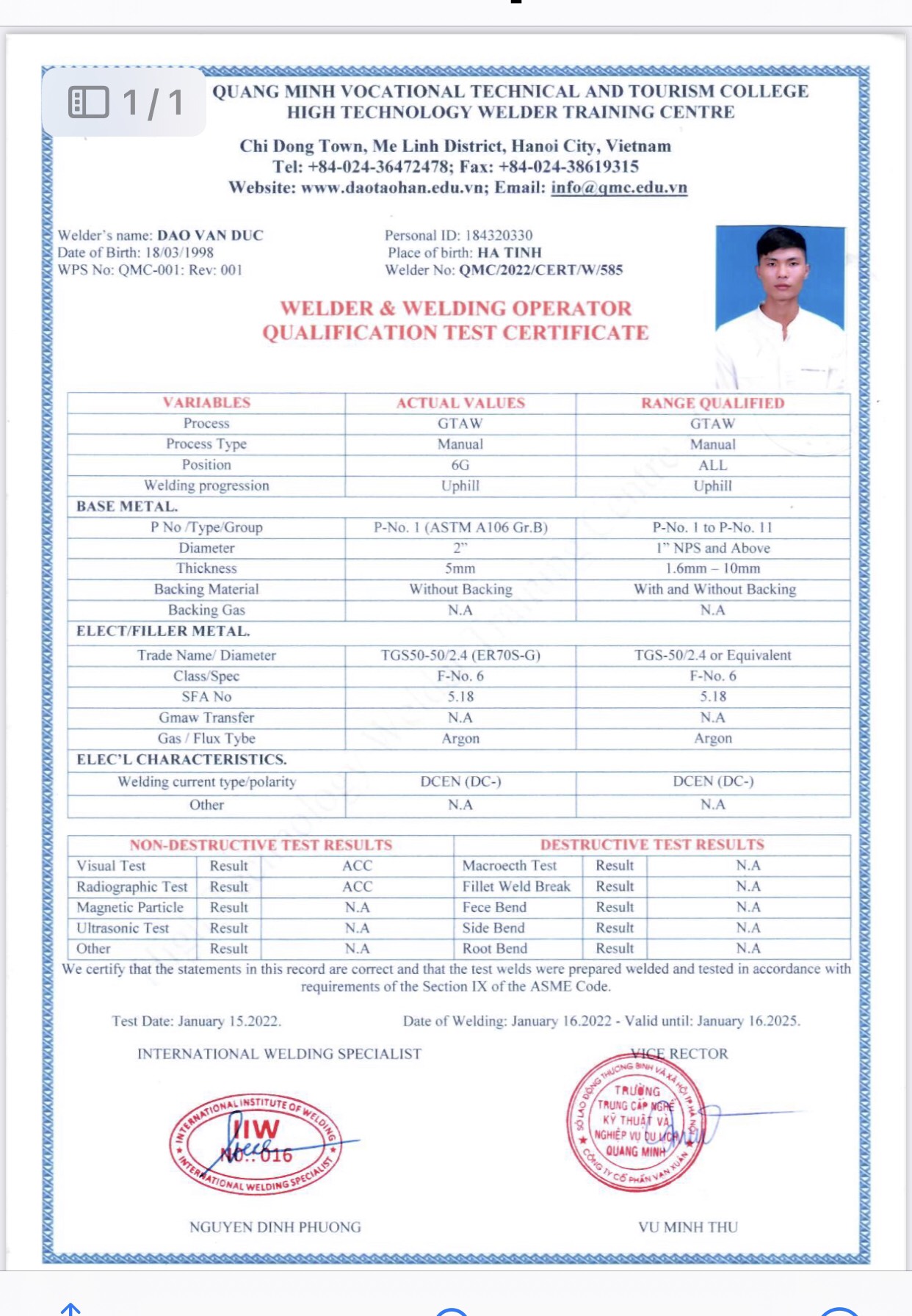
Vietnamese 6G Welder Certification according to International Standards ISO 9606 – AWS – ASME IX – EN287-1
Fabricators and Hull Assembly Workers
Fabricators support the preparation, positioning, and assembly of steel components before welding.
Relevant assessment areas include reading fabrication drawings, measuring dimensions, preparing edges, aligning components, and checking fit-up. Employers may also evaluate familiarity with cutting equipment and the ability to follow assembly sequences.
A practical fabrication test should reveal whether candidates can work accurately and recognize problems before those problems create rework.
Pipe Fitters
Pipe fitting recruitment should distinguish installation and assembly skills from welding qualifications.
Candidates may need to interpret isometric drawings, identify components, prepare fit-up, and assemble piping accurately. Depending on the assignment, employers may also require experience with supports, flanges, valves, or coordination with welding teams.
The job description should identify the pipe materials, dimensions, systems, and level of independent work expected.
Ship Painters and Blasters
Marine painting requires attention to surface preparation, application conditions, equipment handling, and inspection requirements.
Employers should assess candidates against their coating procedures. Relevant experience may include blasting, mechanical surface preparation, masking, spray application, and coating repairs.
Safety preparation should address ventilation, respiratory protection, equipment use, and the hazards of the assigned materials. Recruitment should also establish whether candidates understand the importance of following coating specifications.
Electrical and Other Marine Production Personnel
Vietnamese candidates may also be considered for cable installation, electrical support, mechanical assembly, and other shipbuilding assignments.
Each position requires separate assessment. Cable pulling, termination, testing, and troubleshooting should not be treated as interchangeable skills.
For every occupation, employers should confirm whether the proposed duties qualify under the intended immigration category before proceeding with recruitment.
Korean employers directly assess the skills of Vietnamese welders.
How to Evaluate a Vietnam Shipbuilding Manpower Supplier
A supplier’s value comes from the quality of its recruitment controls and its ability to coordinate with the employer.
Verify the Contracting Entity
Korean employers should establish which Vietnamese company will sign the recruitment agreement and which entity is authorized to handle the relevant overseas employment activities.
The contracting company, operational responsibilities, payment arrangements, and worker support obligations should be clear before a recruitment campaign begins.
Where several companies cooperate, employers should understand how responsibilities are divided. A group brand should not leave uncertainty about the legal entity delivering the service.
Examine Candidate Evidence
A useful candidate profile should contain more than a photograph and a job title.
Employers should request relevant employment history, detailed trade experience, available qualifications, and practical assessment records. Any inconsistency between the application, interview, and test results should be resolved before selection.
Evidence should help the employer compare candidates against the same criteria. A structured shortlist makes decision-making easier and reduces reliance on subjective impressions.
Review Testing Capacity
Ask whether the supplier can reproduce the agreed assessment conditions and maintain reliable records.
For welding recruitment, this may involve preparing the required equipment, materials, test pieces, and inspection arrangements. For fabrication or pipe fitting, it may involve suitable drawings, measurement tools, and assembly tasks.
Employers should also clarify who supervises testing and who has authority to accept or reject candidates.
Assess Communication and Worker Support
International recruitment requires timely coordination between the employer, supplier, candidates, and relevant service providers.
A clear reporting process should cover shortlist progress, test outcomes, document status, and expected next steps. After arrival, employers should have a defined contact for communication problems, worker concerns, and performance follow-up.
A Practical Recruitment Process for Korean Employers
A structured process helps employers make informed decisions and identify problems before mobilization.
Step 1: Define the Workforce Requirement
Prepare a recruitment brief covering:
- Number of workers by trade.
- Detailed duties and work location.
- Required experience and qualifications.
- Technical test specifications.
- Salary, overtime arrangements, and benefits.
- Accommodation and transport arrangements.
- Target arrival schedule.
The brief should also identify the direct employer and explain how the workers will be supervised.
A request for “experienced welders” is difficult to assess consistently. A request describing the welding process, production tasks, and required test gives the supplier a workable sourcing target.
Step 2: Source and Screen Candidates
The supplier identifies potential candidates and checks their experience, documents, motivation, and understanding of the proposed employment.
Screening should explore what candidates have actually done. Questions about materials, equipment, drawings, typical defects, and previous responsibilities can help distinguish relevant experience from general familiarity.
Candidates should receive an accurate explanation of the position before committing to the process.
Step 3: Conduct Interviews and Trade Tests
Technical interviews and practical tests should complement each other.
Interviews help assess experience and communication. Practical tests show whether candidates can perform the required tasks under agreed conditions.
Employers may attend testing directly or use an agreed assessment arrangement. Remote interviews and video records can support review, although they should not replace required inspections or formal assessments.
Step 4: Confirm Selection and Employment Terms
Selected workers should receive a clear explanation of the contract, including pay, working hours, accommodation, deductions, and workplace expectations.
Employers and suppliers should resolve questions at this stage. Misunderstandings about overtime, living costs, or job duties can affect worker confidence and retention after arrival.
Step 5: Coordinate Documentation and Immigration Procedures
Document preparation should begin with a role-specific checklist.
The responsible parties should review candidate identity records, employment evidence, qualifications, employer documents, and any required translations or authentication.
A recruitment schedule should allow time to resolve missing or inconsistent information. Mobilization dates should remain conditional on the necessary approvals.
Step 6: Prepare Workers and Arrange Arrival
Pre-departure preparation should cover practical workplace communication, safety awareness, contract understanding, and living arrangements.
Before travel, confirm arrival coordination, accommodation readiness, transport, induction, and the person responsible for receiving the workers.
E-7-3 Recruitment Support: Confirm the Route for Each Role
Korea’s Ministry of Justice has identified E-7-3 in connection with skilled shipbuilding workers. This provides relevant context for recruitment planning, but it does not establish eligibility for every shipyard position or candidate.
Korean employers should confirm the current occupation classification, candidate requirements, employer eligibility, and supporting documents for each proposed hire.
A job title used in recruitment may not correspond directly to an immigration occupation. Welders, painters, electrical personnel, fabricators, and pipe fitters should therefore be reviewed individually rather than grouped under one assumed visa route.
Employer selection and successful trade testing do not guarantee immigration approval. A responsible supplier supports accurate documentation and coordination while keeping approval decisions separate from recruitment promises.
Employers should obtain current guidance from the relevant Korean authorities or qualified immigration professionals before making firm deployment commitments.
Trade Testing That Reflects Production Needs
The most useful assessment measures the work the candidate will perform.
For welding, the employer should define the procedure and test requirements before recruitment starts. If AWS, ISO, classification society, or other requirements apply, the assessment arrangements should reflect the relevant specification.
A general welding certificate does not automatically establish suitability for every material, process, or position. Employers should review the qualification details and determine whether further testing is needed.
For fabricators, assessment can include drawing interpretation, measurement, component alignment, and fit-up accuracy. Pipe fitting tests can examine isometric reading and assembly. Painting assessments can focus on surface preparation, equipment handling, and application technique.
Candidate records should document the agreed assessment, observed performance, and outcome. Consistent records help employers compare applicants and explain selection decisions.
Training and Preparation Before Deployment
Training should address the gap between a candidate’s existing experience and the employer’s requirements.
Technical Preparation
Where needed, candidates can receive refresher practice on the equipment, processes, or tasks identified during assessment.
Preparation should support genuine skill development. Employers still need to assess whether the worker can perform the job independently at the required level.
Korean Workplace Communication
Basic Korean preparation can focus on tools, measurements, work instructions, safety warnings, and reporting problems.
Workers should be encouraged to ask for clarification when an instruction is unclear. Understanding how to report a hazard or stop an unsafe task is a practical workplace skill.
Safety and Workplace Orientation
Pre-departure safety awareness should introduce relevant hazards, including hot work, lifting operations, confined spaces, working at height, and electrical equipment.
This preparation supports arrival readiness. The employer must still provide site induction, task-specific instruction, and any required authorization before work begins.
Orientation should also explain accommodation rules, attendance expectations, communication channels, and how workers can raise concerns.
Retention Depends on Recruitment and Employment Quality
A recruitment campaign succeeds when selected workers settle into their roles and perform consistently.
Retention begins with realistic job information. Workers need to understand the duties, income structure, living conditions, and expectations before departure.
After arrival, useful measures include a designated supervisor, clear instructions, accessible interpretation, and early performance reviews. Employers should investigate whether a problem comes from skill, communication, training, or unclear expectations before deciding on a response.
Suppliers can support follow-up by maintaining communication with both the employer and workers. Any replacement arrangement should define its conditions and responsibilities clearly.
Recruitment Cooperation with VXT GROUP
VXT GROUP welcomes cooperation with Korean shipbuilding employers, subcontractors, and recruitment partners seeking Vietnamese trade personnel.
A practical partnership starts with reviewing the employer’s requirements, identifying suitable sourcing channels, and agreeing on assessment standards. Recruitment proposals should then describe the responsible contracting entity, scope of service, candidate selection process, and support arrangements.
Employers can begin by sharing their workforce plan, technical specifications, employment conditions, and target schedule. These details provide the basis for evaluating candidate availability and preparing a realistic recruitment campaign.
The goal is to deliver a workforce that matches the assignment and receives the preparation needed to enter the workplace with clear expectations.
Frequently Asked Questions
What does a Vietnam shipbuilding manpower supplier do?
A supplier coordinates candidate sourcing, screening, practical assessments, document preparation, and recruitment communication. The agreed service may also include pre-departure preparation and follow-up after arrival.
Can Korean employers recruit Vietnamese welders?
Vietnamese welders can be considered for Korean recruitment when the candidate, employer, position, and immigration application meet the applicable requirements. Practical testing should reflect the assigned production work.
Are all shipbuilding trades eligible for E-7-3?
Employers should not assume that every shipbuilding trade is eligible. The intended occupation, actual duties, candidate qualifications, and current immigration requirements need individual review.
Can employers conduct trade tests in Vietnam?
Testing in Vietnam can be arranged with suitable facilities and agreed supervision. Employers should specify the test conditions, inspection requirements, and acceptance criteria before candidates are assessed.
How long does recruitment take?
The schedule depends on candidate availability, testing, document readiness, employer procedures, and immigration processing. A realistic timeline should identify these dependencies rather than promise a fixed arrival date.
Which details are needed for a recruitment quotation?
Provide worker numbers, job duties, required skills, work location, compensation, benefits, accommodation, assessment requirements, and the target schedule. These details help define the service scope and recruitment costs.
Does recruitment support guarantee visa approval?
No. Recruitment support can help prepare and coordinate an application, but approval remains subject to the relevant authorities’ review.
How can employers start cooperation with VXT GROUP?
Share a workforce requirement describing the trades, headcount, technical standards, employment conditions, and proposed schedule. The next step is to review sourcing feasibility and agree on a documented recruitment process.
Discuss Your Korean Shipbuilding Workforce Requirements
A reliable Vietnam shipbuilding manpower supplier should connect candidate selection with the employer’s production requirements, immigration planning, and worker preparation.
For Korean employers seeking Vietnamese welders and other marine trade personnel, a clear recruitment brief is the best starting point. Define the work, agree on practical assessment, confirm the employment route, and prepare workers for the conditions they will encounter.
Contact VXT GROUP to discuss your shipbuilding workforce requirements and develop a recruitment plan based on your trades, technical standards, and deployment needs.
Contact Vietnam Manpower Supply Agency today to discuss your specific workforce needs and discover the difference that skilled Vietnamese workers make.
Do you want to hire #workers, seasonal workers and long-term workers from Vietnam?
But you don’t know about:
❓ What kind of service we provide?
👉 Consulting on finding Vietnamese welders
👉 Looking for a supply of welder human resources
👉 Consult about Vietnam’s labor market
👉 Source suitable workers meeting your requirements
👉 Take documents procedures in Vietnam
👉 Train workers languages and vocational skills
👉 Handle problems while Vietnamese workers work in EU
Please contact #Vietnammanpowersupply for #internationalhiring,
We will support you to do all things.
DETALL: #GLOBALSTAFFRECRUITMENT
Tel/Whatsapp: (+84 ) 982 0303 66 – CEO
🌐 LinkedIn: https://www.linkedin.com/company/vietnam-human-resources-group/
Website: vnmanpower.net
Email: namnq.vtc@gmail.com
Youtobe: https://www.youtube.com/@vietnammanpowersupply
#InternationalRecruitmentAgency #ManpowersupplyAgency #vietnammanpowersupply #manpoweragency #manpowersupply #manpowergroup #manpowervietnam #manpowercompany #manpowersupplycompany #Weldersupply #Supplyofshipwelders #weldermanpowersupply